Key Takeaways
- Open-cell foam is soft and spongy; closed-cell is rigid and hard.
- Closed-cell foam bonds more aggressively to timber and is denser — making it harder, slower and more expensive to remove.
- Open-cell removal: approximately £25–40 per m²; closed-cell: approximately £40–65 per m².
- Both types create the same inspection barrier for mortgage surveyors.
- Closed-cell on roof timbers is also the higher-risk scenario for moisture trapping.
- A site survey is needed for a fixed quote — these are guide ranges only.
Open-Cell vs Closed-Cell: The Difference
Spray foam comes in two fundamentally different formulations, and the type matters both for the risks it creates and the cost of removing it.
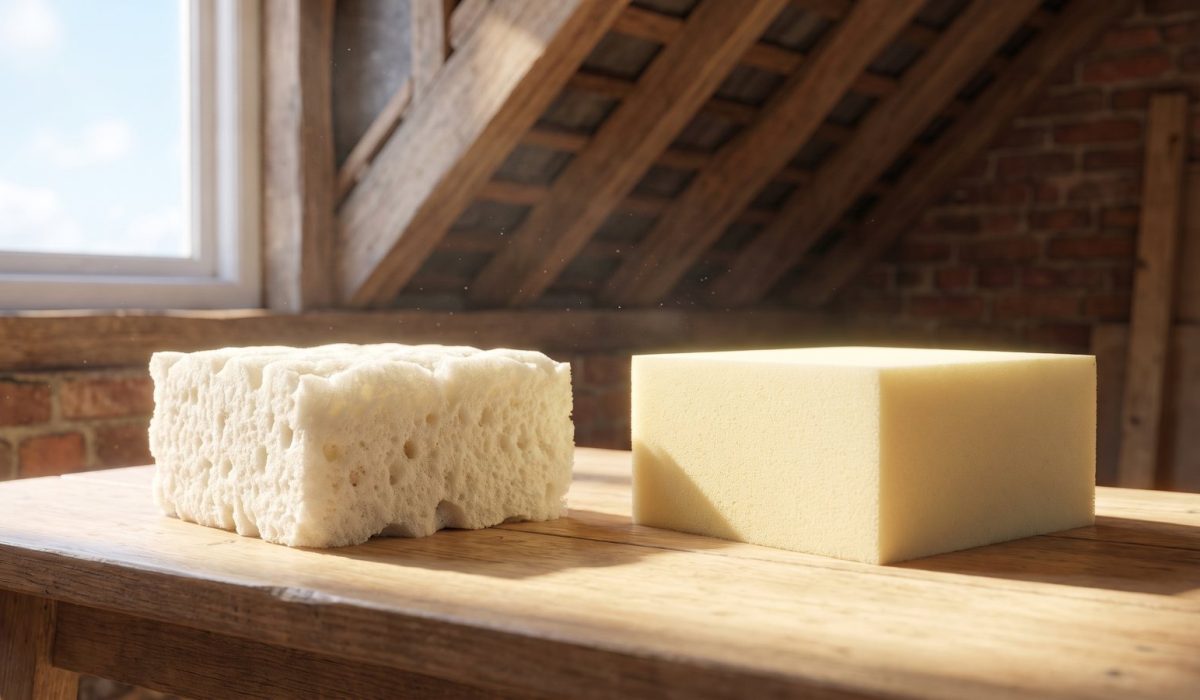
Open-cell foam expands to a soft, spongy consistency after application. Its cellular structure is not fully sealed — the cells are open, giving the material a degree of vapour permeability. It is lighter than closed-cell, typically off-white or cream coloured, and compresses when pressed with a finger. Most open-cell foam was sold to homeowners as a “breathable” product, though its interaction with non-breathable underlays and unventilated voids still creates concerns.
Closed-cell foam expands to a rigid, dense structure. Its sealed cellular matrix makes it water-resistant and highly impermeable to water vapour. It feels hard and does not compress under hand pressure. It is typically yellow or cream-coloured and has a noticeably different texture — almost polystyrene-like. Closed-cell foam is used in applications where rigidity and moisture resistance are priorities, but when applied directly to roof rafters in existing homes, these same properties create both a significant moisture-trapping risk and a substantially more difficult removal job.
Why Closed-Cell Is Harder (and More Expensive) to Remove
The cost difference between open-cell and closed-cell removal comes down to three factors:
Density. Closed-cell foam is significantly denser than open-cell. Greater density means more material to physically break down and remove per square metre of roof area. It also means the foam is heavier — which affects how it is handled and disposed of.
Bond strength. Closed-cell foam bonds very firmly to whatever surface it has been applied to. On rough-sawn roof timbers, it can achieve an exceptionally strong mechanical bond. Breaking that bond without damaging the timber beneath requires careful, methodical work — and experienced operatives using appropriate tools. Rushing the job risks gouging into the wood, which then requires costly repairs.
Time. The combination of greater density and stronger bonding means each square metre of closed-cell foam takes meaningfully longer to remove than the equivalent open-cell area. Labour cost is a significant component of removal pricing; more time means more cost.
For these reasons, the indicative cost for closed-cell removal — approximately £40–65 per m² — is roughly 50–60% higher than open-cell at £25–40 per m².
Price Ranges by Foam Type
| Foam type | Removal cost per m² | Typical 100m² loft total |
|---|---|---|
| Open-cell | £25–40 | £2,500–£4,000 |
| Closed-cell | £40–65 | £4,000–£6,500 |
| Difficult access (either type) | Add £5–15 per m² | — |
These are guide ranges as of June 2026. Individual quotes will vary based on specific property conditions — access, loft configuration, foam thickness, timber condition, and scope of work. Only a site survey provides a fixed price.
Additionally, all quotes should be checked to confirm whether they include waste disposal, timber repairs (if needed), re-insulation, and the independent RICS removal certificate — costs that are sometimes excluded from headline figures. See our hidden costs guide for a full breakdown.
How to Tell Which Type You Have
You can often identify the foam type yourself with a simple test in your loft:
- Press your hand firmly against the foam surface. If it compresses or gives — soft, spongy, springy — you likely have open-cell foam.
- If the surface is hard and rigid, with no compression under hand pressure — more like dense polystyrene than soft foam — you likely have closed-cell foam.
- Open-cell foam tends to look fluffy or uneven at the surface. Closed-cell tends to look more uniform and solid.
Bear in mind that this test tells you the foam type but not the condition of the timber beneath — which is the thing that actually matters for your roof’s structural integrity and mortgage status. Only an independent PCA-protocol inspection can assess the timber condition.
The Bottom Line
Identify your foam type — then get an itemised site survey quote from at least three reputable firms. Closed-cell will always cost more to remove, but both types are removable, and both types require a professional rather than a DIY approach.
Request a quote or book an independent inspection to get started.
This is general information, not financial advice — please consult a qualified mortgage broker about your circumstances.
Related reading: How much does spray foam removal cost in 2026? · The hidden costs of spray foam removal · Open-cell vs closed-cell: which is worse for roofs?