Key Takeaways
- Installation and curing represent the highest-risk phase: isocyanates and VOCs are present at elevated levels.
- Isocyanate sensitisation is serious and can occur during professional or amateur installation without proper respiratory protection.
- Fully cured foam is generally considered chemically inert under normal conditions.
- People with chemical sensitivities or respiratory conditions may be more cautious with any synthetic insulation material.
- HSE and industry guidance (IMA) address safety requirements for installation.
- The primary, better-evidenced concerns for homeowners are structural and financial — moisture, rot and mortgage access — not chronic health effects from cured foam.
Installation vs Cured Foam: A Critical Distinction
The health risk profile of spray foam changes dramatically between two phases:
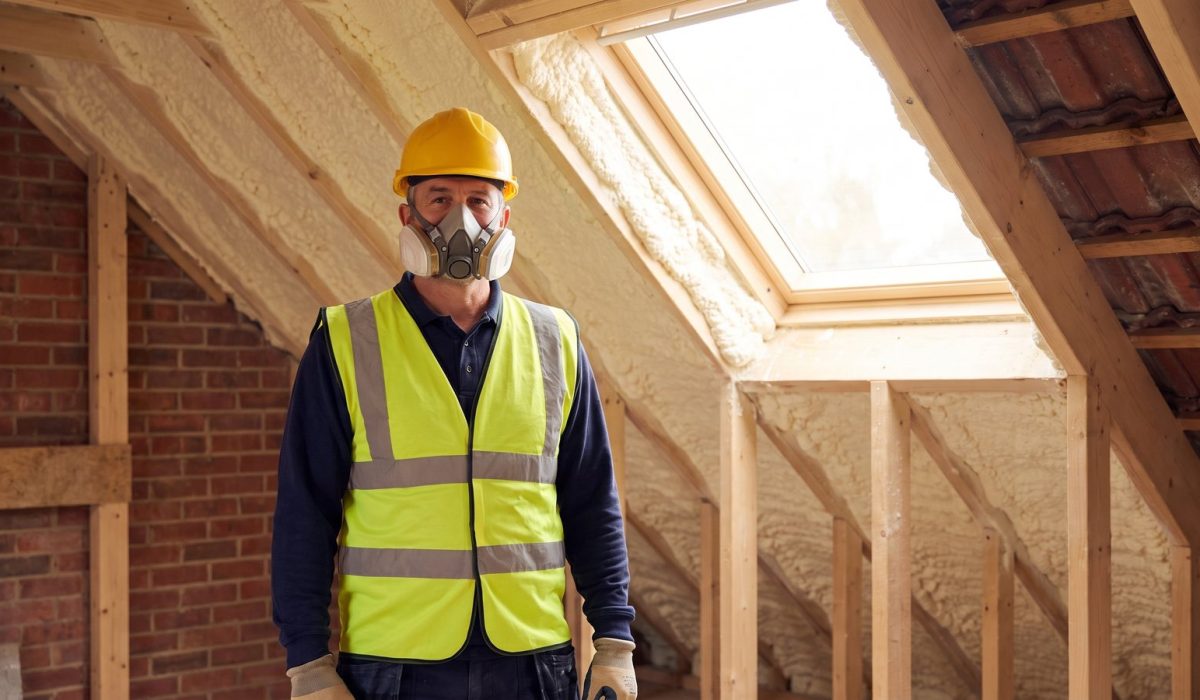
During installation and curing. Spray foam systems consist of two components that react together to form the foam — typically isocyanate (MDI or pMDI) and a polyol blend. During and shortly after application, unreacted chemicals and reaction by-products are airborne as vapours and aerosols. This phase requires:
– Full respiratory protection (appropriate respirators, not dust masks) for operatives
– Eye and skin protection
– Adequate ventilation of the work area
– Exclusion of building occupants until the foam has fully cured and the area is adequately ventilated
The Health and Safety Executive (HSE) has specific guidance on isocyanate safety in the workplace, and the Insulation Manufacturers Association (IMA) provides product-specific safety guidance for installers.
Fully cured foam. Once the foam has fully cured — typically within 24–72 hours depending on the product and conditions — the chemical reaction is complete. The resulting polymer is generally considered stable and inert under normal temperature and use conditions. Cured foam is not expected to off-gas significant quantities of hazardous chemicals under typical domestic conditions.
VOCs and Isocyanates
Isocyanates are the most significant occupational health hazard in spray foam installation. Isocyanate sensitisation — where repeated exposure causes the immune system to become sensitised — can lead to occupational asthma. Once sensitised, an individual may react to extremely low isocyanate concentrations that would not affect non-sensitised people.
This is a serious risk for professional installers who work regularly with these materials without adequate protection. For homeowners, the exposure risk is typically confined to the period when installation was being carried out in their home. Sensitisation from a single installation event is possible but less common than from repeated occupational exposure.
VOCs (volatile organic compounds) are present in most building materials at some level. Spray foam systems contain VOC components in their formulations. During installation and curing, VOC off-gassing occurs. The rate of off-gassing decreases rapidly as the foam cures. Most product certifications (BBA, Kiwa) include assessment of VOC emissions.
Who May Be More Sensitive
Certain groups of people may be more cautious about any synthetic insulation material, including cured foam:
- Those with existing respiratory conditions (asthma, COPD) may be more reactive to low-level emissions from any VOC-containing building material.
- Those with chemical sensitivities — sometimes described as multiple chemical sensitivity — may experience symptoms from concentrations that most people do not react to.
- Pregnant women may wish to take a precautionary approach to chemical exposures, including those from building materials.
For these groups, the cautious approach during any spray foam removal project would be to ensure adequate ventilation of the property during and after the work.
What the Guidance Says
HSE: The Health and Safety Executive’s guidance on isocyanates focuses primarily on occupational exposure — workers who apply, remove or work with foam professionally. HSE sets Workplace Exposure Limits (WELs) for isocyanate compounds. For domestic occupants in a finished building, isocyanate exposure from cured foam under normal conditions is not considered a significant occupational health concern.
IMA: The Insulation Manufacturers Association provides guidance to the professional installation sector on best practice for spray foam application, including health and safety requirements during the installation process.
Public Health England/UKHSA: No specific public health guidance has been issued addressing health risks to domestic occupants from cured spray foam insulation in their homes.
Practical Takeaways
If you are living in a home with spray foam that was professionally installed and fully cured: day-to-day health risk from the foam itself is generally limited. The principal concerns — moisture, condensation, ventilation, and mortgageability — are structural and financial rather than toxicological.
If you had spray foam installed recently and have ongoing symptoms (respiratory irritation, headaches, eye irritation) that you associate with the installation: seek medical advice and ensure the property is well ventilated. Some curing is more prolonged at lower temperatures; also ensure your foam was installed by a qualified operative.
During removal: spray foam removal releases foam particles and dust, and may re-expose occupants to chemicals if the property is occupied during the process. Professional removal firms take precautions to contain the work area. Vacating the property during removal is advisable.
The Bottom Line
Present the evidence accurately: the health risks of spray foam are most significant during installation, most relevant to professional applicators, and diminish substantially once the foam is fully cured. Living with cured foam carries limited documented health risk under normal conditions. The dominant, better-supported reasons for removal are structural and financial.
Book an independent inspection to understand the structural risk picture for your property.
This is general information, not financial advice — please consult a qualified mortgage broker about your circumstances.
Related reading: Is spray foam insulation a fire risk? · 7 warning signs your spray foam is causing problems · Spray foam insulation in 2026: pros, cons & the UK reality