Key Takeaways
- DIY removal does not produce the independent RICS-verified certificate that mortgage lenders need.
- Physical risks include damage to rafters, electrical wiring, and potential isocyanate dust exposure.
- Without a professional surveyor’s sign-off, lenders will still treat your property as a foam-affected property.
- DIY is rarely genuinely cheaper when the costs of rework, repairs, and professional remediation are factored in.
- Professional removal by an insured, experienced firm is the only route that actually resolves the mortgage issue.
The Lender Certification Problem
This is the most important point: even a perfectly executed DIY removal does not solve the mortgage problem.
Mortgage lenders require, as evidence that a spray-foam-affected property has been resolved, an independent RICS-verified certificate. This certificate is issued by an independent RICS surveyor who visits the property after removal, assesses the exposed timbers, and confirms the foam has been fully removed and the roof is in acceptable condition.
An independent RICS surveyor will not certify a DIY removal job in the same way as a professional, insured, properly executed removal. The surveyor needs confidence in the completeness and standard of the work — and a DIY operation, by definition, lacks the professional oversight and accountability that creates that confidence.
Without the certificate, your lender still sees a foam-affected property — because from their perspective, you have no independent verification that the problem has been resolved. The mortgage barrier remains.
The Real Risks of DIY Removal
Beyond the certification problem, there are real practical risks:
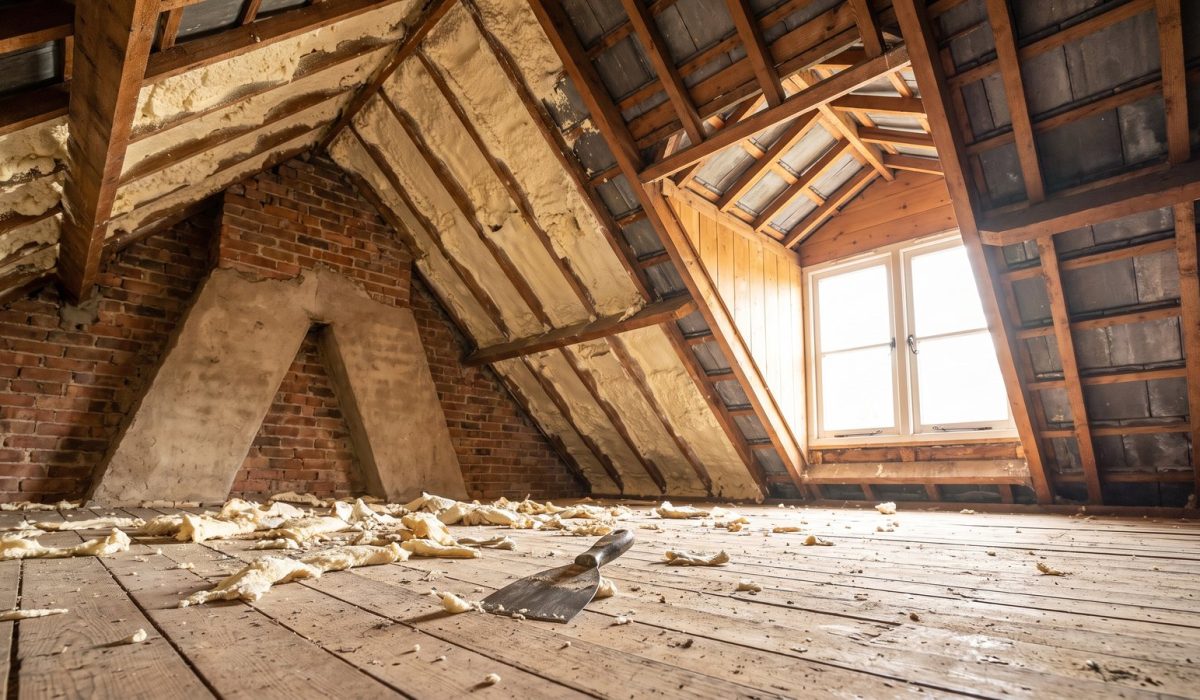
Timber damage. Closed-cell foam bonds extremely firmly to roof timbers. Attempting to remove it with inappropriate tools — chisels, scrapers, angle grinders — creates a high risk of gouging into and damaging the rafters beneath. Damaged rafters are a structural issue that then requires professional repair, costing more than the removal would have cost in the first place. Even with open-cell foam, improper technique can dislodge nails, damage underlay, or disturb the structural geometry of the roof.
Health exposure. Removing spray foam — particularly if any uncured residue is present, or if the foam is disturbed aggressively — generates dust and potentially volatile organic compounds. Proper respiratory protection (not a simple dust mask — a half-face respirator with appropriate filtration) is required. Without this, the person carrying out the removal is exposed to particles and potential chemical residues in an uncontrolled environment.
Electrical hazards. Roof spaces contain electrical cabling — supplying loft lighting, smoke detectors, and sometimes other services. Foam often encases or runs close to cabling. DIY removal without identifying and managing the cable routes creates a real risk of cutting or damaging electrical wiring.
Incomplete removal. Professional removal aims for complete removal of foam from all surfaces. DIY removal often results in partial removal — sections of foam left in awkward corners, at eaves, or where access is restricted. Partial removal is not sufficient for an RICS certificate, and a subsequent professional remediation visit to complete the job adds cost and delay.
Why DIY Is Rarely Cheaper
On the face of it, avoiding professional labour costs seems like a saving. In practice:
- Any timber damage caused by DIY removal requires professional repair — at a cost that often exceeds the labour saving.
- Incomplete removal requires professional completion — at the full professional rate, on top of the time already spent DIY.
- Without a certificate, the mortgage problem remains. You then either need to pay for professional removal to be redone properly, or remain unable to sell, remortgage, or release equity.
- The hidden costs of the situation continuing — SVR mortgage rates, failed sale transactions — are real and ongoing.
When the full cost of DIY — direct costs plus the cost of consequences — is compared to professional removal producing a lender-accepted certificate, professional removal is consistently the better value.
The Professional Route
A professional removal by an insured, experienced specialist firm:
– Uses appropriate equipment and techniques to remove foam cleanly without timber damage
– Manages health and safety properly for operatives and occupants
– Documents the removal process
– Arranges an independent RICS-verified certificate on completion
– Provides the evidence base that mortgage lenders actually need
How professional removal works covers the full process in detail.
The Bottom Line
DIY foam removal creates risks without delivering the outcome you need. The certification requirement — the independent RICS-verified certificate that lenders require — cannot be obtained from a DIY job. Professional removal is not just the safer option; it is the only option that actually resolves the mortgage situation.
Request a professional removal quote from a firm that includes an independent RICS certificate.
This is general information, not financial advice — please consult a qualified mortgage broker about your circumstances.
Related reading: How is spray foam professionally removed? · Spray foam removal certificate: what it proves · How to choose a spray foam removal company