Key Takeaways
- Recommended total depth: 270–300mm of mineral wool in a two-layer installation.
- Install in two layers: ~100mm between joists, ~170mm cross-laid above.
- Target U-value: 0.16 W/m²K (verify current Building Regulations requirements).
- Ventilation above the insulation layer is non-negotiable — use eaves baffles.
- More insulation is not always better beyond the recommended depth — diminishing returns apply.
- Spray foam on the roof slope (rather than mineral wool on the loft floor) is the cautionary example of what not to do.
Recommended Depth: The UK Standard
The Energy Saving Trust recommends a total loft insulation depth of 270–300mm for most UK homes. This two-part installation achieves a U-value of approximately 0.16 W/m²K — the target set by the UK government’s energy efficiency standards.
The installation is typically carried out in two layers:
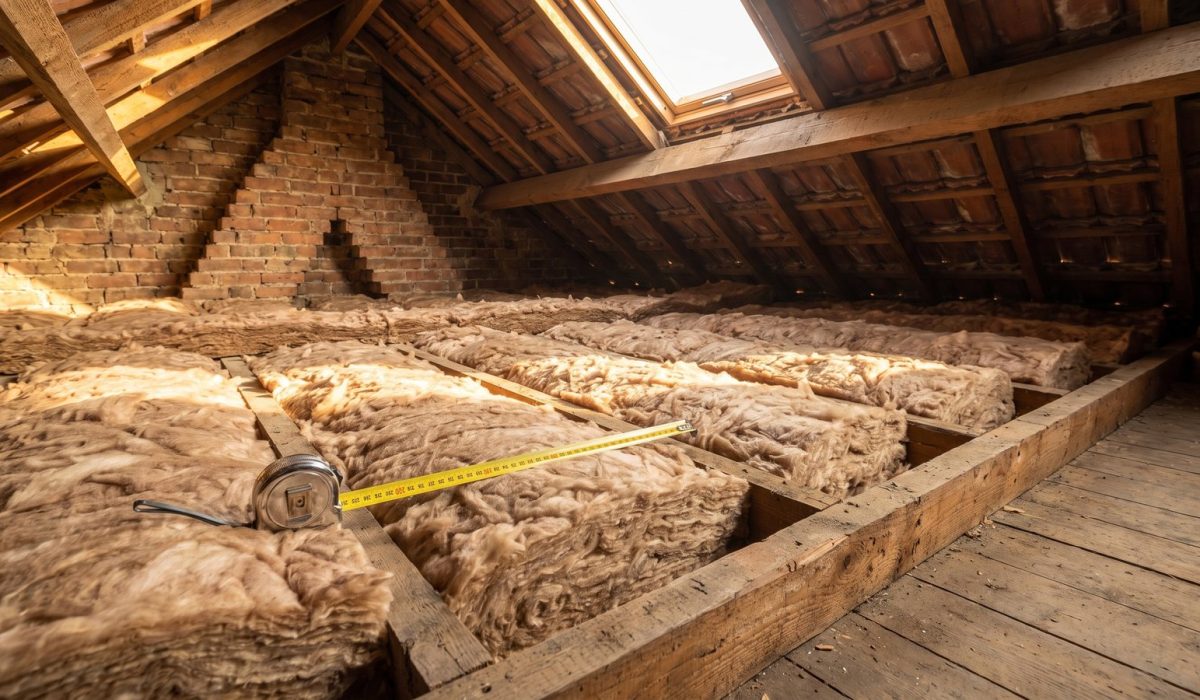
First layer (between joists): Approximately 100mm of mineral wool rolls or batts are laid between the joists on the loft floor. This fills the joist void. In many older homes, existing insulation at this layer is already present — often at 100mm or less.
Second layer (cross-laid above): Approximately 170mm of mineral wool is then laid at 90 degrees across the top of the joists. This cross-laying avoids thermal bridging through the joists themselves and achieves the full recommended depth.
The result — 100mm + 170mm = 270mm — is the minimum for current recommendations. Some sources and the most current Energy Saving Trust guidance (energysavingtrust.org.uk) suggest 300mm is preferable. Check the current guidance for the most up-to-date recommendation.
Material Choices
Mineral wool (glass wool or rock wool) is the default and most widely available option. It is breathable, non-combustible, cost-effective, and accepted without qualification by all mainstream mortgage lenders. Available in roll form from all major builders’ merchants and DIY stores.
Natural fibre insulation (sheep’s wool, hemp, wood fibre, cellulose) achieves equivalent performance at the same depth and is preferred by those with environmental priorities. Breathable, lender-accepted, and marginally more expensive. See our alternatives guide for detail.
Can you have too much insulation? The law of diminishing returns applies. Beyond 300mm, additional thickness delivers progressively smaller improvements in U-value. The recommended 270–300mm is the sweet spot between cost and performance. Very deep insulation can also create practical problems in a loft that is sometimes used for storage.
Why Ventilation Matters
However thick your insulation, the ventilation void above it must remain clear. In a traditional cold-roof construction, air enters at the eaves and exits at or near the ridge, keeping the roof structure dry.
When installing or topping up loft insulation, always:
– Install ventilation baffles (eave rafter trays) between rafters at the eaves before laying the second insulation layer. These prevent the insulation from blocking the eaves ventilation gap.
– Do not push insulation into the eaves beyond the baffle.
– Check that any ridge ventilation, if present, is also clear.
Blocking the ventilation path — even with breathable insulation — recreates some of the moisture problems associated with spray foam, though to a lesser degree.
Topping Up vs Replacing
If your loft already has some insulation — perhaps 50–100mm of mineral wool from a previous installation — you may only need to top up rather than start from scratch.
Check the existing depth by measuring with a ruler or tape measure in the loft. If it is below 270mm, add the required additional depth as a second cross-laid layer.
Check the existing condition. Insulation that has been compressed (by storage on loft boards), that is wet, mouldy, or otherwise degraded, should be removed rather than topped up. Wet or mouldy insulation has lost much of its thermal performance and may indicate a moisture problem that should be investigated.
Spray foam is not a top-up material. Do not apply spray foam over existing insulation, or as an “upgrade” to a loft floor installation. This is the practice that has led to tens of thousands of problem properties.
Cost to Insulate
For reference:
– Mineral wool rolls (materials only for DIY): approximately £150–£300 for a standard 100m² loft
– Professionally installed mineral wool: approximately £300–£800
– Natural fibre insulation (professional install): approximately £600–£1,500
At current energy prices, the payback period for full-depth loft insulation is typically two to five years in energy savings. After payback, the saving is ongoing.
Grants may be available for eligible households — see our grants guide.
The Bottom Line
270–300mm of mineral wool in a two-layer installation, with eaves baffles, is the answer. It achieves the required U-value, maintains breathability, preserves ventilation, and is accepted by every mortgage lender without question. It is also the opposite, in every relevant respect, of spray foam on the roof slope.
Request a loft insulation quote or book an inspection to assess your current insulation status.
This is general information, not financial advice — please consult a qualified mortgage broker about your circumstances.
Related reading: Best mortgage-friendly loft insulation alternatives · How to insulate a loft properly (2026 guide) · Loft insulation grants 2026: who can still get help