Key Takeaways
- All recommended alternatives are breathable — preserving the ventilation your roof needs.
- Mineral wool (glass or rock wool) is the most widely used, cost-effective, and universally accepted option.
- Natural fibre insulation (sheep’s wool, hemp, wood fibre) is breathable, environmentally preferred, and lender-accepted.
- Rigid insulation boards can be used in rafter-level applications with a maintained ventilation void.
- Multifoil reflective insulation works in specific configurations with correct air gaps.
- None of these materials creates the surveyor inspection barrier or moisture-trapping risk associated with spray foam.
Why Breathability Matters to Lenders and Surveyors
Spray foam created two distinct problems: it physically prevented surveyors from inspecting the timber, and it potentially blocked the roof’s ventilation. Any alternative insulation should avoid both of these.
Breathable materials — those that allow some degree of moisture vapour movement — maintain the moisture management function of the roof. They do not create an impermeable seal against the timber. They do not block eaves ventilation when installed correctly. And crucially, they do not bond to roof timbers in a way that prevents future inspection.
The result is a roof that can breathe, can be surveyed, and will be accepted by mortgage lenders without qualification.
Mineral Wool
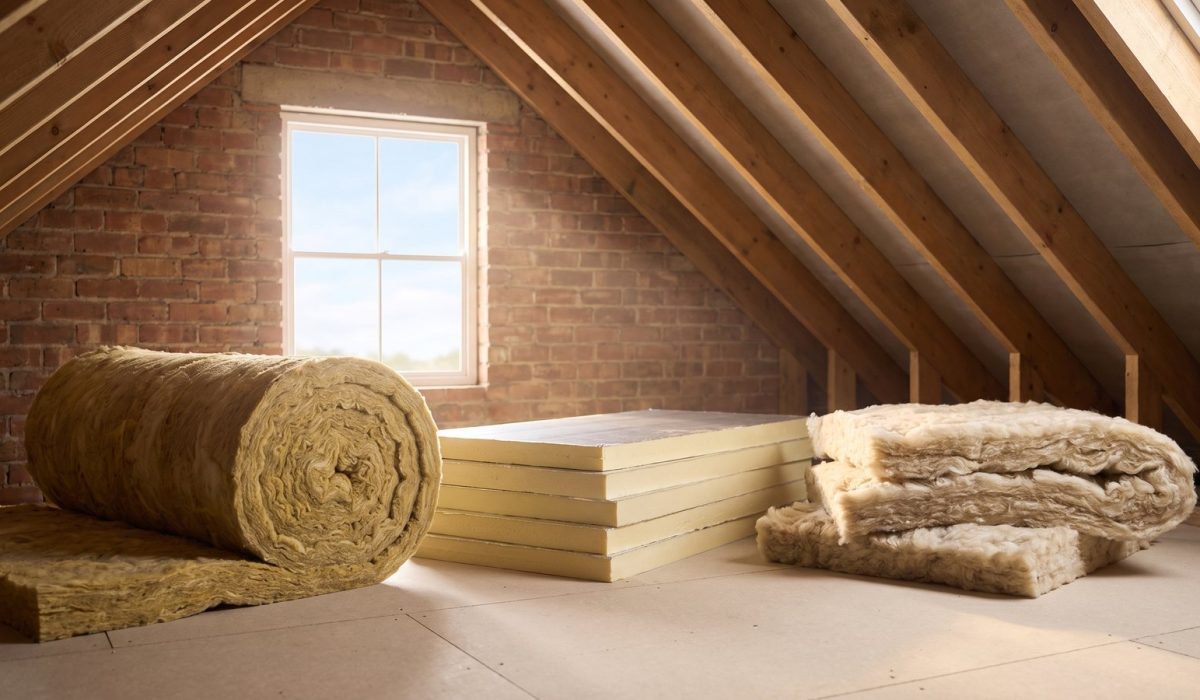
What it is: Mineral wool — including glass wool (fibreglass) and rock wool (stone wool) — is the most widely installed domestic insulation material in the UK. It is a manufactured fibre made from molten glass or volcanic rock and is available in rolls, batts, or blown loose-fill.
Performance: At the recommended depth of 270–300mm (typically a 100mm layer between joists and 170mm layer across the top), mineral wool achieves a U-value well within Building Regulations requirements. It provides good acoustic performance in addition to thermal insulation.
Breathability: High. Mineral wool is vapour-open — moisture can diffuse through it freely. It does not trap moisture against roof timbers and does not create the condensation conditions associated with closed-cell foam.
Fire performance: Non-combustible (A1 classification). Mineral wool does not burn, does not produce flaming drips, and does not contribute to fire spread. This is a significant advantage over spray foam.
Mortgage acceptance: Universal. No mainstream mortgage lender has objections to properly installed mineral wool at ceiling/joist level in a loft. It is the standard material for post-removal re-insulation.
Cost: Approximately £300–£800 for a standard 100m² loft at recommended depths. Lower if the homeowner installs it; higher for professional installation with associated services.
Natural Fibre Insulation
What it is: A category of insulation materials derived from natural, renewable sources — most commonly sheep’s wool, hemp, wood fibre (wood wool boards or flexible batts), and cellulose (recycled paper). Each has slightly different properties.
Performance: Comparable to mineral wool at equivalent depths. Natural fibres have the advantage of being hygroscopic — they can absorb and release moisture without degrading, which is a useful property in a roof environment.
Breathability: High. Natural fibre materials are inherently vapour-open. Some (particularly sheep’s wool and wood fibre) have beneficial moisture-buffering properties, absorbing excess humidity and releasing it when conditions improve.
Mortgage acceptance: All mainstream mortgage lenders accept properly installed natural fibre insulation. There is no lender concern about these materials.
Cost: Approximately £600–£1,500 for a standard 100m² loft — typically 50–100% more than mineral wool. The premium reflects both material cost and the fact that these products are manufactured in smaller volumes.
Rigid Insulation Boards
What it is: Rigid polyisocyanurate (PIR) or polyurethane (PUR) boards — high-performance rigid insulation panels used in a range of construction applications.
Application in lofts: Rigid boards can be used at rafter level — installed between and below rafters — as part of a warm-roof upgrade. Critically, their use at rafter level requires a ventilation gap to be maintained between the board surface and the underlay/tiles above. Without this gap, they replicate the ventilation-blocking problem of spray foam.
Breathability: PIR/PUR boards are not vapour-open in the same way as mineral wool. Their correct use in rafter-level applications requires careful design and either breathable underlay or a maintained ventilation void.
Mortgage acceptance: When correctly installed as part of a designed system with adequate ventilation management, rigid boards are accepted. Their use should be part of a professionally designed system, particularly at rafter level.
Cost: Typically higher per m² than mineral wool, but achieves significantly better U-values at lower thickness.
Multifoil Insulation
What it is: Multi-layer reflective insulation products — thin, lightweight systems consisting of multiple layers of reflective material (typically aluminium) with various core materials. Commonly used in agricultural and commercial buildings and increasingly in residential roof applications.
See our dedicated multifoil guide for detailed performance and use-case assessment.
Choosing the Right Option
| Material | Best for | Typical cost (100m²) | Breathable | Lender-accepted |
|---|---|---|---|---|
| Mineral wool | Standard post-removal re-insulation | £300–£800 | Yes | Yes |
| Natural fibre | Environmental preference | £600–£1,500 | Yes | Yes |
| Rigid boards | Rafter-level (warm roof, with ventilation) | Varies | Design-dependent | Yes (if ventilated) |
| Multifoil | Specific configurations with air gaps | £400–£900 | Yes (with air gaps) | Yes |
The Bottom Line
Any breathable, properly installed alternative is a significant improvement on the spray foam situation from a mortgage, ventilation, and fire safety perspective. Mineral wool is the default for good reason — it is effective, affordable, and universally accepted. Choose breathability; choose an installer who understands roof ventilation; and keep the roof able to breathe.
Book an inspection to establish your re-insulation needs or request a removal and re-insulation quote.
This is general information, not financial advice — please consult a qualified mortgage broker about your circumstances.
Related reading: Mineral wool vs spray foam: which to choose? · Multifoil insulation after spray foam removal · Re-insulating your loft after removal: options & cost