Key Takeaways
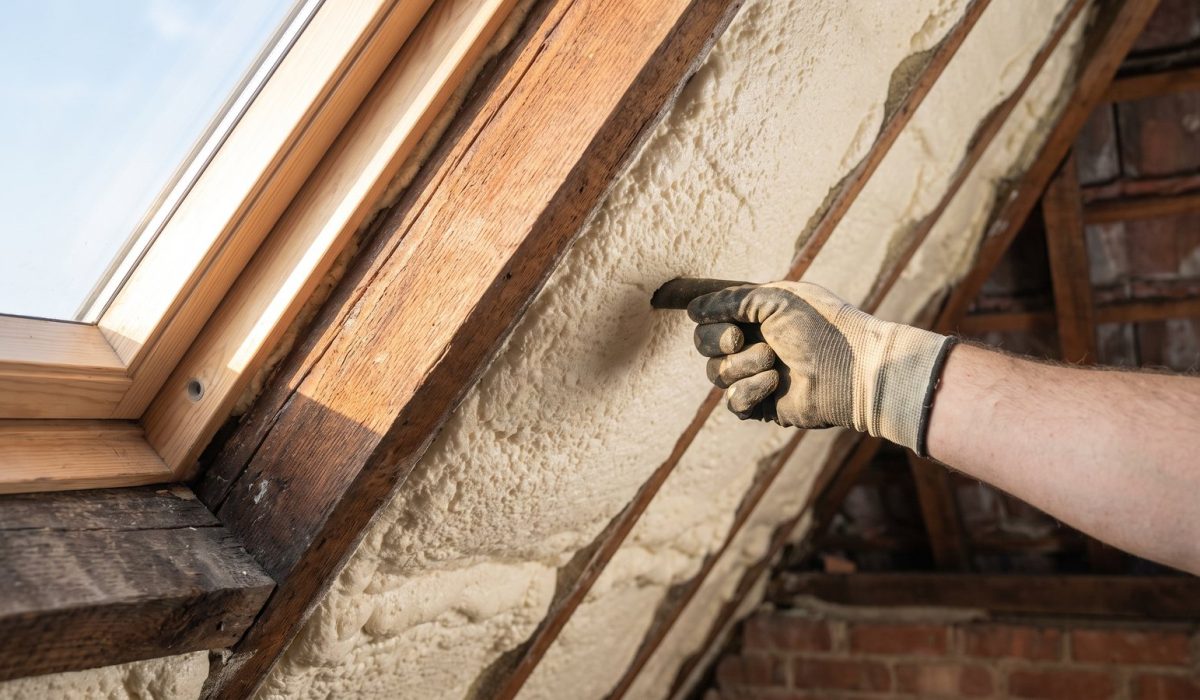
- Spray foam on roof timbers looks like a continuous foam layer coating the underside of rafters and the underside of the roof covering.
- Open-cell is soft and compressible; closed-cell is hard and rigid.
- You can often identify the type yourself with a simple touch test.
- The timber condition beneath the foam is not assessable by eye or touch — only a professional inspection can establish this.
- If in doubt — or if your loft is difficult to access — commission a professional inspection rather than relying on self-assessment.
Where to Look
Spray foam in a residential roof is typically applied to the underside of the roof slope — the surfaces you can see when you look up inside the loft. This includes:
- The underside of the roof tiles or slates (or the underlay beneath them)
- The rafter surfaces (the sloping timber members running from eaves to ridge)
- Potentially the ridge board, gable wall surfaces, or party wall top
In most installations, the foam covers the entire underside of the roof slope from eaves to ridge. It may appear as a uniform, continuous layer, or it may have visible expansion texture — bubbled or mounded in places.
If your loft has roll or batt insulation on the loft floor (horizontal surface) only — and no insulation on the sloping roof surface — you do not have spray foam applied to the rafters. The spray foam problem relates specifically to foam applied to the roof slope timbers.
Open-Cell vs Closed-Cell: How to Tell
The simplest test is physical:
Press the foam surface firmly with the flat of your hand or a couple of fingers. Apply meaningful pressure.
- If it compresses, gives, and springs back when you release — soft and spongy — you likely have open-cell foam.
- If it is hard and rigid, with no perceptible compression — more like polystyrene or dense expanded foam — you likely have closed-cell foam.
Visual clues:
– Open-cell tends to have a rougher, more uneven surface texture — it looks like it expanded vigorously and solidified mid-movement. It is often off-white or light cream.
– Closed-cell tends to look more uniform and solid, with a smoother or slightly waxy surface. It may be yellow, cream, or tan coloured and appears denser.
Colour is not a reliable identifier on its own — different products come in different colours — but combined with the texture and hardness test, it usually provides a clear answer.
What You Cannot Tell Yourself
You can identify the foam type. What you cannot reliably establish yourself:
The condition of the timber beneath the foam. The rafters are covered by the foam. Surface timber is not visible, not tappable, and not probeable. Any moisture damage, rot, or decay beneath the foam surface is inaccessible without professional involvement.
Whether the ventilation void has been adequately preserved. The eaves area is often the most difficult part of the loft to access, and it is where ventilation paths enter. Assessing whether eaves ventilation is clear typically requires getting close to the eaves with a torch and some experience of what to look for.
The installation quality. Whether the foam was installed correctly, to what depth, over what underlay type, and with what provisions for ventilation management — these are technical assessments that require expertise.
The overall risk classification. Only a surveyor working to the PCA Spray Foam Inspection Protocol can produce a formal risk classification that can be presented to a mortgage lender or broker.
When to Get a Professional Inspection
In most circumstances where spray foam is present and you need to sell, remortgage, or release equity from the property, a professional PCA-protocol inspection is not just advisable — it is necessary. The informal self-assessment described above is useful for initial planning, but it does not produce the documentation lenders or brokers require.
Book an independent PCA-protocol inspection if:
– You are planning to sell or remortgage in the next two years
– Your mortgage has been declined or flagged due to spray foam
– You have noticed any of the warning signs of moisture damage
– Your loft is difficult to access, limiting your ability to self-assess
– You want an objective, documented picture of the roof’s condition
The Bottom Line
You can identify your foam type — and that knowledge is useful for estimating removal cost and understanding the risk profile. But the information that actually matters for mortgages and structural integrity is the timber condition beneath, which only a professional inspection can establish.
Book an independent PCA-protocol inspection — it is the appropriate tool for knowing what you’re actually dealing with.
This is general information, not financial advice — please consult a qualified mortgage broker about your circumstances.
Related reading: Open-cell vs closed-cell: which is worse for roofs? · The PCA Spray Foam Inspection Protocol explained · 7 warning signs your spray foam is causing problems