Key Takeaways
- A healthy roof breathes: air circulates through a void between the insulation and the roof covering, carrying away moisture.
- Spray foam — particularly closed-cell — can seal this void entirely, trapping moisture against cold timber.
- The condensation cycle deposits water on timber surfaces repeatedly, raising moisture content and creating conditions for rot.
- BS 5250:2021 (British Standard for moisture management) addresses this; many grant-era foam installs did not follow its requirements.
- Open-cell foam is somewhat less risky than closed-cell, but can still cause condensation problems in the wrong configuration.
- An independent inspection assesses whether your specific roof is affected.
How a Roof Is Meant to Breathe
In a traditional cold-roof construction — the most common design in UK residential properties — the roof is designed with a clear separation between the warm insulated space and the cold roof covering (tiles or slates). Between them is a ventilation void, typically maintained by the shape of the rafters and any counter-batten arrangement.
Air enters this void through ventilation gaps at the eaves (soffit vents, tile spacers), travels up the slope of the roof, and exits at or near the ridge. As it moves, this airflow carries with it water vapour that has escaped from the warm interior of the house. The result is that moisture-laden air is continuously refreshed with drier outside air, keeping the roof structure at a safe moisture content.
Building Regulations Approved Document F (ventilation) and BS 5250:2021 (Code of Practice for moisture management in buildings) both address the requirements for this ventilation to be maintained in residential roofing.
How Foam Disrupts Ventilation
When spray foam is applied to the underside of the roof covering — the rafters, the underlay, or both — it can fill the ventilation void that the roof was designed to maintain. In a typical grant-era installation, the installer was focused on achieving good thermal performance (reducing heat loss through the roof slope) and less focused on preserving the ventilation pathway.
Closed-cell foam, with its rigid, impermeable structure, can create a near-complete seal when applied at adequate thickness. The ventilation void disappears; the pathway for moist air to escape is blocked.
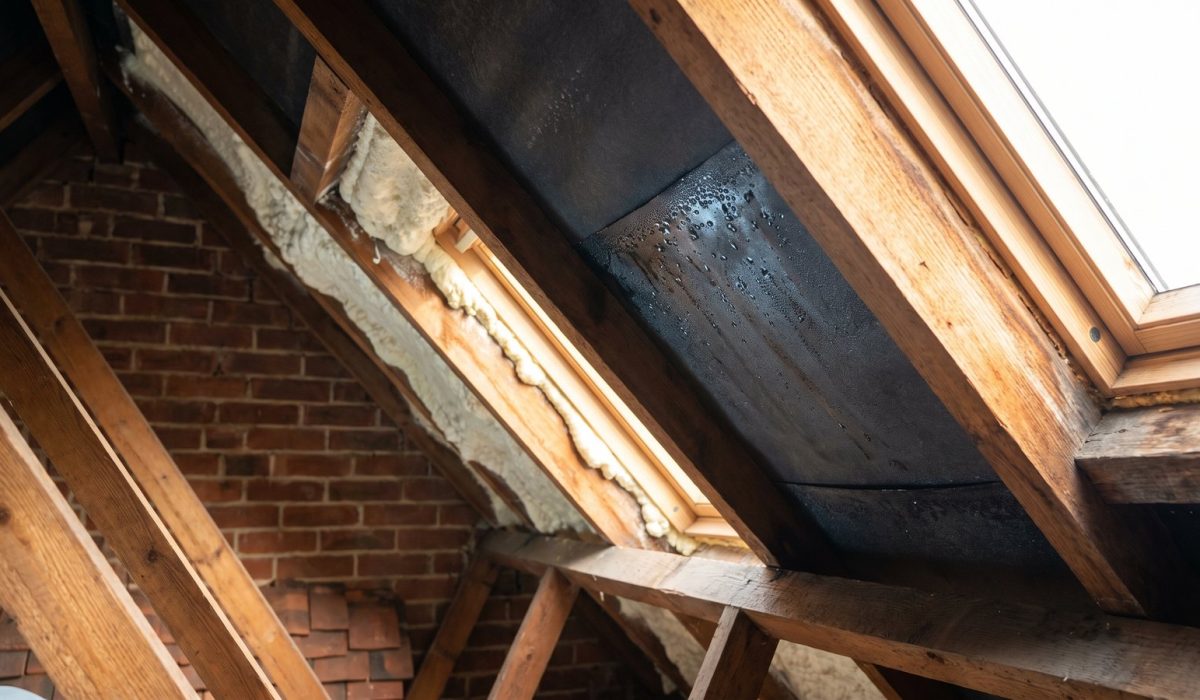
The result is a sealed, warm-side layer meeting a cold roof covering — exactly the conditions that produce condensation.
The Condensation–Rot Cycle
Once ventilation is blocked, the condensation cycle begins:
- Warm moist air (generated by cooking, breathing, bathing and other household activities) diffuses upward through the ceiling and into the roof space.
- In the absence of adequate ventilation, this air accumulates and eventually meets the cold surface of the roof covering from the warm side.
- At the cold surface, the air temperature drops below the dew point, and water vapour condenses into liquid water.
- This liquid water deposits onto or close to the timber rafters.
- Repeatedly wetted timber, given insufficient time to dry, builds up moisture content above the threshold for biological decay (typically above 20% moisture content by weight).
- Mould, then rot fungi, establish themselves. Over months and years, structural timber strength is compromised.
This cycle is invisible at ceiling level until the damage is substantial. Homeowners frequently discover significant timber decay only when foam is professionally removed as part of a pre-sale or remortgage resolution.
Open-Cell vs Closed-Cell: The Vapour Permeability Difference
The two types of spray foam behave differently in this context, though neither is without risk in a poorly ventilated configuration:
Open-cell foam has an imperfect cellular structure — the cells are not fully sealed, giving the material some degree of vapour permeability. In principle, open-cell foam allows some moisture movement. In practice, its interaction with non-breathable underlay and blocked eaves ventilation still creates problems, though typically less severe than closed-cell.
Closed-cell foam is highly impermeable to water vapour. Its sealed-cell structure offers very high resistance to vapour diffusion. Applied at significant thickness over a non-breathable underlay with blocked eaves ventilation, closed-cell foam creates the most aggressive moisture-trapping conditions. This is why closed-cell on pitched-roof timbers is considered the higher-risk scenario — by surveyors, lenders, and building science bodies alike.
Spotting It Early
Condensation damage in a foam-affected roof is easier to address at an early stage than a late one. Signs to look for include those described in our warning signs guide: musty smells in the loft, visible moisture on cold surfaces, staining on ceilings below the roof slope, and discoloured or damaged foam.
However, many cases develop without any obvious surface signs — which is precisely why an independent inspection is the only reliable way to assess the roof’s condition.
The Bottom Line
The condensation risk from spray foam is a ventilation risk: when foam seals the pathway that keeps roof timbers dry, moisture accumulates and damage follows. That damage is hidden by the foam — which is exactly why surveyors and lenders are concerned, and why an independent inspection is always the right first step.
Book an independent inspection to assess your roof’s moisture status.
This is general information, not financial advice — please consult a qualified mortgage broker about your circumstances.
Related reading: Spray foam & timber rot: what to look for · Spray foam & roof ventilation explained · 7 warning signs your spray foam is causing problems