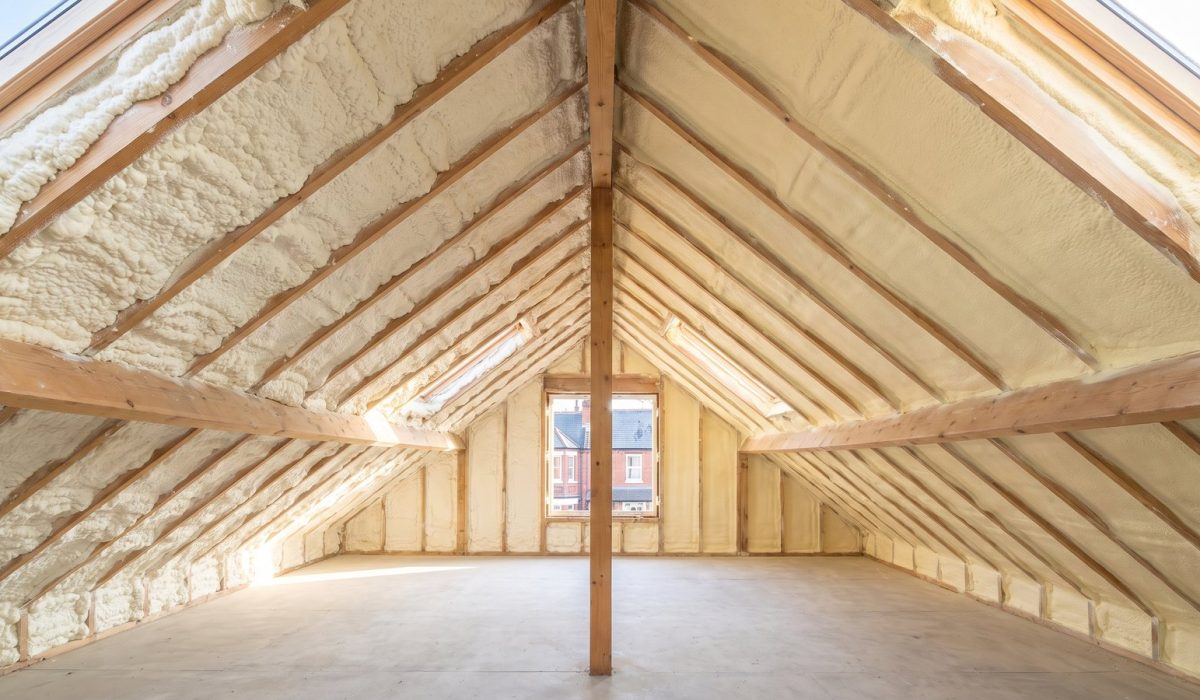
Key Takeaways
- Open-cell foam is soft, spongy, and vapour-permeable; closed-cell is hard, rigid, and impermeable.
- Closed-cell foam is more likely to trap moisture against roof timbers — higher risk of condensation and rot.
- Both types prevent surveyors from inspecting timbers — both create the mortgage barrier.
- Closed-cell is significantly more expensive to remove: approximately £40–65/m² vs £25–40/m² for open-cell.
- Neither type is “acceptable” to most mainstream lenders without supporting documentation.
- An independent inspection establishes which type you have and assesses the risk in your specific roof.
The Two Types Explained
Spray polyurethane foam is manufactured in two fundamentally different formulations:
Open-cell foam expands aggressively and achieves its insulating performance through its large volume and the still air trapped in its cellular structure. The cell walls are not fully sealed, giving the material a degree of vapour permeability. It is soft and spongy — compressible under hand pressure. It is lighter than closed-cell and is typically applied at greater thickness to achieve equivalent thermal resistance.
Closed-cell foam expands to a denser, more rigid structure. Its cells are fully sealed, trapping the blowing agent gas (typically a hydrocarbon) within the cell structure. This gives closed-cell foam its characteristic rigidity, high compressive strength, and water resistance. It is harder and denser than open-cell — it does not compress under hand pressure. It achieves higher thermal resistance per unit thickness.
Moisture and Breathability Differences
The key difference for roof performance is vapour permeability:
Open-cell has a relatively high moisture vapour transmission rate — it allows water vapour to diffuse through the material. In principle, this means that if moisture does enter the foam, it can escape more readily than with closed-cell. In practice, however, the moisture risk in a foam-affected roof is primarily at the interface between the foam and the cold roof covering, not within the foam body. The vapour permeability of open-cell foam does not fully compensate for a blocked ventilation void.
Closed-cell has very low vapour permeability — it is nearly impermeable to water vapour. Applied to the underside of roof timbers over a non-breathable underlay, with no ventilation void, it creates conditions where moisture accumulates and has nowhere to go. The combination of cold surfaces, trapped humid air, and impermeable foam produces the most aggressive condensation conditions.
This is why closed-cell foam on roof timbers is specifically identified as the higher-risk scenario in industry and lender guidance.
Why Both Affect Mortgages
Despite the difference in moisture risk, both types of foam create the same surveyor inspection barrier:
The timber cannot be inspected through either type of foam. Whether the foam is soft and spongy (open-cell) or hard and rigid (closed-cell), a surveyor cannot see through it, tap through it, or probe the wood beneath. The RICS guidance that drives lender behaviour is not differentiated by foam type — it is based on the inability to assess the timber, which applies equally to both.
This is an important point for homeowners who assume that having open-cell foam means their mortgage situation is straightforward. It does not. Open-cell foam, like closed-cell, triggers surveyor flags and lender restrictions in virtually all cases.
Removal Differences
The difference in density and bond strength creates a meaningful difference in removal cost and complexity:
| Factor | Open-cell | Closed-cell |
|---|---|---|
| Texture | Soft, spongy | Hard, rigid |
| Bond to timber | Moderate | Very strong |
| Removal effort | Lower | Higher |
| Typical cost per m² | £25–40 | £40–65 |
| Timber damage risk during removal | Lower | Higher |
Closed-cell foam’s strong bond to timber requires more careful, time-intensive removal to avoid damaging the rafters beneath. This is why professional removal is essential for both types — but particularly critical for closed-cell.
The Bottom Line
Closed-cell foam on roof timbers is the more problematic type — on moisture risk, on removal difficulty, and on cost. But open-cell is not without its problems: it creates the same mortgage barrier and still poses a ventilation concern in poorly configured installations. Neither type is risk-free; both require assessment and, in most cases requiring mortgageability, removal and certification.
Book an independent inspection to establish which type you have and what your options are.
This is general information, not financial advice — please consult a qualified mortgage broker about your circumstances.
Related reading: Open-cell vs closed-cell removal: why the price differs · Spray foam & condensation: why it traps moisture · How to tell if you have spray foam (and which type)