Key Takeaways
- Mineral wool achieves excellent thermal performance at recommended depths (270–300mm) — comparable to foam in practical terms.
- Mineral wool is breathable, non-combustible, and universally accepted by mortgage lenders.
- Spray foam offers airtightness and high R-value per unit thickness, but carries moisture, ventilation and lender-restriction risks on UK pitched roofs.
- Cost comparison: mineral wool is typically cheaper overall when total cost of spray foam scenarios (removal, certification) is included.
- Mineral wool is the recommended choice for standard UK loft insulation — and the unanimous choice for post-removal re-insulation.
Performance and Thermal Properties
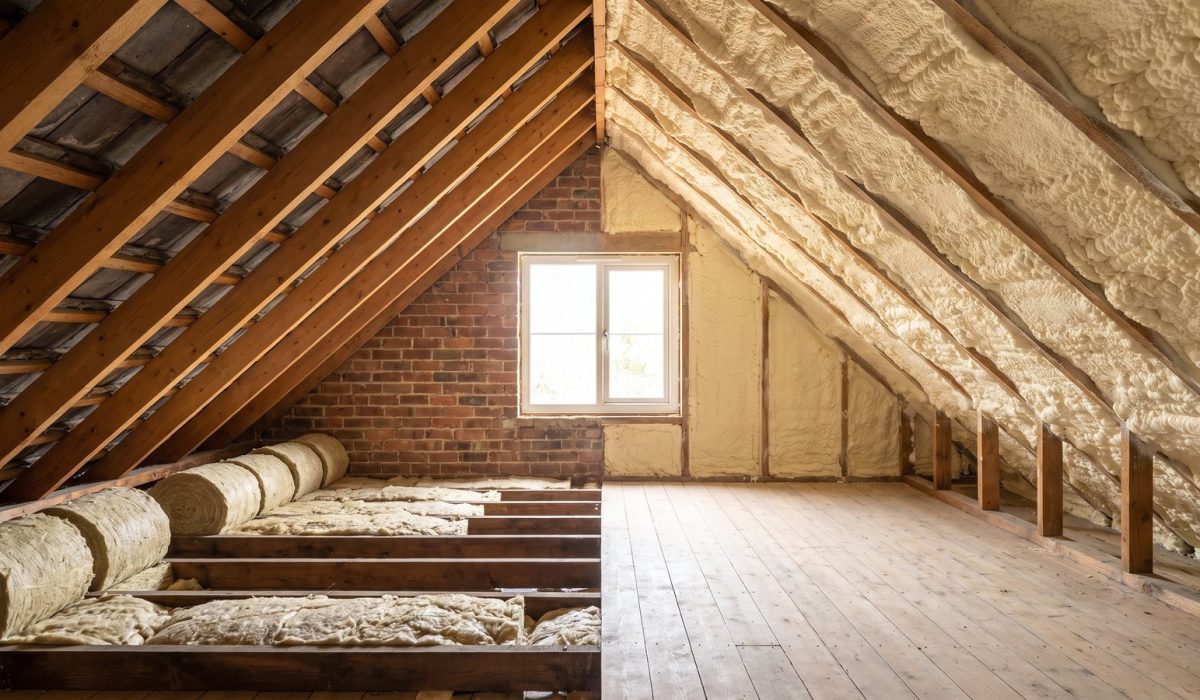
Mineral wool achieves excellent thermal insulation at the recommended depth. The UK standard for loft insulation — mineral wool laid at 270–300mm depth across the loft floor — produces a U-value well below the threshold for Building Regulations compliance. Heat loss through a properly insulated mineral wool loft is minimal.
Mineral wool also provides good acoustic performance — reducing sound transmission between floors.
Spray foam offers a higher R-value (thermal resistance) per unit thickness than mineral wool. This means less thickness is needed to achieve the same thermal resistance. This is one reason it was marketed for retrofit applications — it can insulate a shallow rafter void that would not accommodate mineral wool rolls.
However, the thermal advantage of spray foam is meaningful primarily where thickness is genuinely constrained (shallow rafter depth, for example). In a typical loft floor application — where depth is not the limiting factor — mineral wool at the recommended 270–300mm achieves excellent performance, and the foam’s advantage per unit thickness is practically irrelevant.
Moisture and Breathability
Mineral wool is vapour-open — moisture can diffuse through it freely. It does not impede the natural moisture movement in a roof structure. It maintains the ventilation function of the roof and does not create condensation conditions in standard correctly designed applications.
Spray foam — particularly closed-cell — is highly impermeable to water vapour. Applied to the underside of roof rafters over non-breathable underlay, without a maintained ventilation void, it creates the moisture-trapping conditions described throughout our problem guides. The thermal advantage of spray foam on a pitched roof is often outweighed by the moisture and ventilation risk it introduces in the UK retrofit context.
Open-cell foam is somewhat more vapour-permeable, but still creates an inspection barrier and can contribute to ventilation disruption in the wrong configuration.
Mortgage Acceptance
Mineral wool: universally accepted by all mainstream UK mortgage lenders. No lender has concerns about mineral wool insulation applied correctly at ceiling/joist level in a loft. A mortgage surveyor finding mineral wool in a loft will not flag it in their report.
Spray foam: restricted or refused by approximately 75% of mainstream mortgage lenders, as of June 2026. All equity-release lenders refuse. The restriction is because surveyors cannot inspect the roof timbers through the foam — a problem that simply does not arise with mineral wool or any other conventionally installed loft insulation.
Cost and Lifespan
Mineral wool costs approximately £300–£800 for a standard 100m² loft at recommended depths (professional installation). It has an expected lifespan of 40+ years with no maintenance requirement. There are no future removal costs.
Spray foam installation costs vary, but the critical additional consideration is the potential future removal cost: £2,800–£8,000 for a standard 100m² loft, plus additional costs for repairs, re-insulation, and RICS certification (see our cost guide). When the total lifecycle cost — including eventual removal — is compared, spray foam on a pitched roof is typically more expensive than mineral wool over time.
The Verdict for UK Roofs
| Factor | Mineral wool | Spray foam (retrofit, pitched roof) |
|---|---|---|
| Thermal performance | Excellent at recommended depth | Higher per unit thickness |
| Breathability | High — vapour-open | Low (closed-cell) to moderate (open-cell) |
| Mortgage acceptance | Universal | Restricted by ~75% of lenders |
| Fire performance | A1 — non-combustible | Combustible (with flame retardants) |
| Installation cost | £300–£800 | Variable |
| Future removal cost | None | £2,800–£8,000+ |
| Surveyor inspection barrier | None | Yes — blocks timber inspection |
For UK roofs and mortgageability, mineral wool wins on every factor that matters for the long-term ownership of a residential property.
The Bottom Line
For UK residential lofts and mortgaged properties, mineral wool is the straightforwardly superior choice: effective, breathable, non-combustible, lender-accepted, and without the future removal cost that foam creates. It is the default recommendation — for new installations, and for re-insulation after spray foam removal.
Request a re-insulation quote or book an inspection to assess your loft’s insulation needs.
This is general information, not financial advice — please consult a qualified mortgage broker about your circumstances.
Related reading: Best mortgage-friendly loft insulation alternatives · Is spray foam removal worth it? · How to insulate a loft properly