Key Takeaways
- Post-removal timber inspection is essential — this is when the true condition of the rafters is first visible.
- Timber repairs may be needed: typically £200–£1,000+ depending on the extent of moisture damage or rot.
- Ventilation must be restored — blocked eaves vents and foam residue near the eaves need clearing.
- Re-insulation with breathable, lender-friendly materials is the final structural step.
- Re-insulation costs: approximately £300–£1,500+ depending on material and area.
- An independent RICS certificate follows all of the above.
Inspecting Timbers After Removal
The removal of foam exposes the rafters for the first time — often for years. This is the moment of truth for the roof’s structural condition. An experienced operative (and, separately, the independent RICS surveyor who will issue the certificate) should systematically assess:
Visual inspection. Each rafter is examined for discolouration, surface mould (grey-green or black patches), staining, and any visible decay. Areas near the eaves — where condensation is most likely to have accumulated — and near the ridge are examined most carefully.
Moisture meter readings. A calibrated moisture meter is used to measure the moisture content of timber at multiple points along each rafter. Sound, dry timber typically reads below 18–20% moisture content by weight. Readings above this threshold indicate elevated moisture that, sustained, creates conditions for rot.
Structural probe. Where visual assessment or moisture readings suggest concern, a trained inspector may probe the timber surface — gently pressing with a tool to check for softness or sponginess that would indicate active rot beneath the surface.
Ventilation assessment. The eaves area and ridge are assessed to confirm that ventilation pathways are clear and that airflow through the void can be restored once re-insulation is installed.
Repairs You Might Need
Not all properties need significant post-removal repairs — many are found to have sound timber once the foam is stripped back. Where repairs are needed, they fall into several categories:
Surface mould treatment. Mould on the surface of otherwise sound timber is treated with appropriate biocidal solutions and allowed to dry. This is typically included in the removal contract rather than being a separate cost. The surface mould does not indicate structural failure — only that moisture was elevated.
Localised wet rot treatment and repair. Where sections of timber have early-stage wet rot — soft, spongy, darkened wood — those sections may be cut out and replaced with new structural timber of the same dimensions. This is a standard repair for a skilled joiner working in a loft environment. Cost: approximately £200–£600 for localised repairs involving a few sections.
More extensive structural timber work. Where rot has progressed over a larger area — multiple rafters, significant sections of ridge board or purlins — the repair scope and cost is greater: potentially £600–£1,000+ depending on the extent. Severe cases — widespread structural decay — can cost more. These are relatively uncommon in properties where the foam is addressed before catastrophic progression.
Restoring eaves ventilation. Foam that extended right to the eaves may have blocked soffit vents or the ventilation gap above the wall plate. Clearing foam residue, reinstating ventilation baffles or spacers, and confirming that air can enter at the eaves is an essential step that is often included in the removal scope.
Re-insulation Options
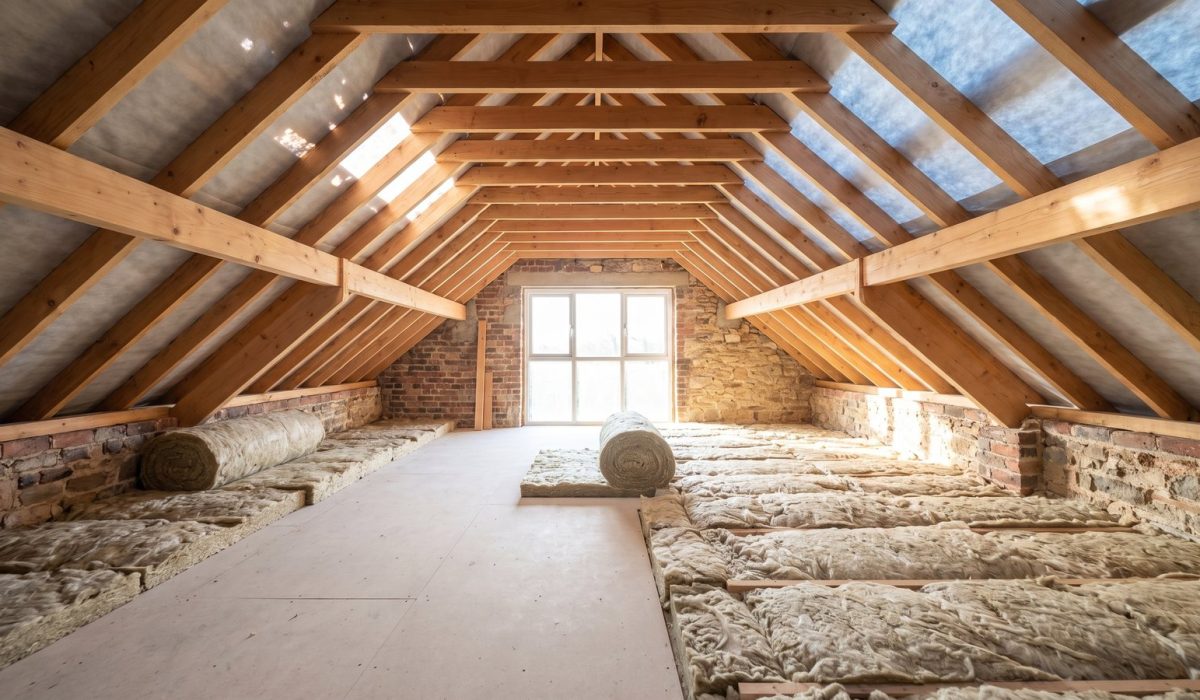
Once the timbers are assessed and any repairs made, re-insulation restores the loft’s thermal performance and brings the property back to a good EPC rating. The key principle for post-removal re-insulation is breathability — any material that reintroduces the moisture-trapping characteristics of foam is counterproductive.
The standard options:
Mineral wool (glass wool or rock wool) is the most widely used and universally accepted material. It is breathable, non-combustible, cost-effective, and supported by all mainstream mortgage lenders. Available as rolls (laid between and over joists) or blown loose-fill (for hard-to-reach areas). Cost for a standard 100m² loft: approximately £300–£800 at recommended depths.
Natural fibre insulation (sheep’s wool, hemp, wood fibre, cellulose) is breathable, environmentally preferred, and lender-accepted. Performance is comparable to mineral wool; cost is typically higher. Approximately £600–£1,500 for the same area.
Rigid insulation boards (PIR/PUR) can be used in some configurations — typically at rafter level with a maintained ventilation void above. They require careful installation to preserve ventilation and are not the standard post-removal choice for traditional loft floors, though they have applications in specific rafter-level configurations.
Multifoil systems can be appropriate in some configurations — see our multifoil guide for detail.
See our full alternatives guide for a comparison.
Does This Restore Your EPC?
Removing foam and re-insulating with breathable material at proper depth (typically 270–300mm of mineral wool) will restore and often improve your property’s EPC rating relative to the post-foam state. A loft properly insulated with breathable material may achieve a better EPC outcome than incorrectly installed foam that has compromised the roof’s moisture management.
An updated EPC should be commissioned after re-insulation — both because it is required for marketing the property, and because a good EPC rating is a selling point.
The Bottom Line
Removal opens the door; repairs and re-insulation complete the job. Budget for both from the start, choose breathable materials, and plan the whole sequence — removal, repairs, re-insulation, RICS certificate — as a managed package.
Request a fully scoped quote or book an inspection to start the process.
This is general information, not financial advice — please consult a qualified mortgage broker about your circumstances.
Related reading: How is spray foam professionally removed? · Best mortgage-friendly loft insulation alternatives · The hidden costs of spray foam removal