Key Takeaways
- Spray foam is combustible and will burn when exposed to direct flame.
- Certified products must meet fire performance standards relevant to their application context.
- The highest fire risk period is during installation and the immediate curing phase.
- Mineral wool insulation is non-combustible by comparison.
- The principal documented problems with spray foam in UK homes are moisture, ventilation and mortgageability — fire risk is a secondary and less-evidenced concern.
- Always check product certification (BBA, Kiwa) for the specific foam used in your property.
How Spray Foam Behaves in Fire
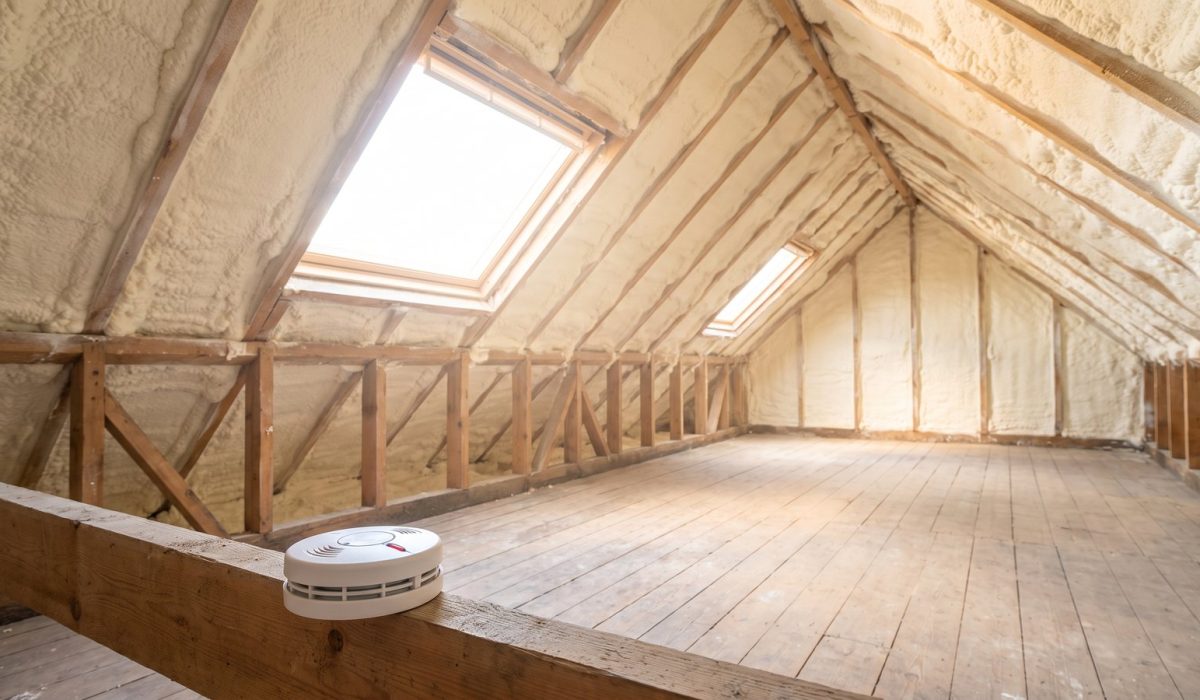
Spray polyurethane foam (SPF) is an organic polymer — like most organic materials, it will burn when exposed to sufficient heat or flame. The fire behaviour of a specific product depends on its chemical formulation, any flame-retardant additives included, and the thickness of the application.
When ignited, spray foam can produce:
– Heat and flame propagation along the foam surface
– Dense, toxic smoke
– Flaming drips in some formulations
These properties are why fire performance standards matter: Building Regulations in England and Wales (and their equivalents in Scotland and Northern Ireland) impose requirements on the fire performance of insulation materials, particularly in roof spaces, where a fire could spread rapidly.
Spray foam is not uniquely dangerous compared to many other organic insulation materials. It requires flame-retardant treatment to meet regulatory standards, and certified products have this treatment included in their formulation.
What Standards and Certifications Require
For spray foam to be used legally in UK residential construction, it must be assessed against relevant standards and typically hold a certification from a recognised body such as:
- British Board of Agrément (BBA) — the most widely recognised UK certification for construction products, including spray foam systems. BBA certificates specify the approved use cases, application methods and performance limitations of a specific product.
- Kiwa — another accredited certification body that provides similar product assessment.
Building Regulations Approved Document B (fire safety) sets requirements for the fire performance of materials used in roofs — in particular, their contribution to fire spread. Certified spray foam products are assessed against these requirements as part of their certification.
When spray foam is installed without a valid BBA or Kiwa certificate — or in an application context not covered by its certificate — there is no assurance that it meets the required fire performance standards. This applies to some of the lower-quality installations made under grant schemes in 2020–2022.
Comparison with Mineral Wool
By comparison, mineral wool (glass wool or rock wool) insulation is non-combustible — classified A1 or A2 on the European fire reaction classification scale. It does not burn, does not produce flaming drips, and does not contribute to fire spread. In many fire safety risk assessments, mineral wool is the preferred insulation material precisely because it does not add to fire load.
This does not mean spray foam is categorically unsafe — certified products in appropriate applications have an established track record — but it does mean that mineral wool has a straightforwardly stronger fire safety profile. For homeowners choosing post-removal insulation, this is one of several reasons mineral wool is the default recommendation.
Practical Considerations
Installation and curing. The period of highest fire risk associated with spray foam is during application and the immediate post-application curing window. During this phase, the foam is still chemically active, and precautions — including ventilation of the work area and prohibition of ignition sources — are essential. A qualified, trained installer manages these precautions; DIY application carries significant additional risk during this phase.
Finished, cured installations. In a finished installation where the foam has fully cured and is not in direct contact with ignition sources (flame, heat sources), the day-to-day fire risk from properly certified foam is limited. It is not an active fire hazard under normal household conditions.
Loft fire scenarios. In the event of a loft fire from any cause — electrical fault, ember from chimney, arson — the presence of combustible insulation (spray foam or otherwise) in the loft space would contribute to fire spread. Mineral wool would not. This is a secondary fire safety consideration rather than an acute daily risk.
The Bottom Line
Spray foam is combustible, but in properly certified installations it is not an acute fire hazard under normal conditions. The fire performance profile of mineral wool insulation is superior — and mineral wool is the recommended re-insulation material after removal. But the dominant, better-evidenced concerns driving the case for removal in most UK homes are moisture, ventilation and mortgage access — not primarily fire safety.
Book an independent inspection to get an objective picture of your property’s specific risk profile.
This is general information, not financial advice — please consult a qualified mortgage broker about your circumstances.
Related reading: Spray foam & condensation: why it traps moisture · Spray foam health risks: what the evidence says · Mineral wool vs spray foam: which to choose?