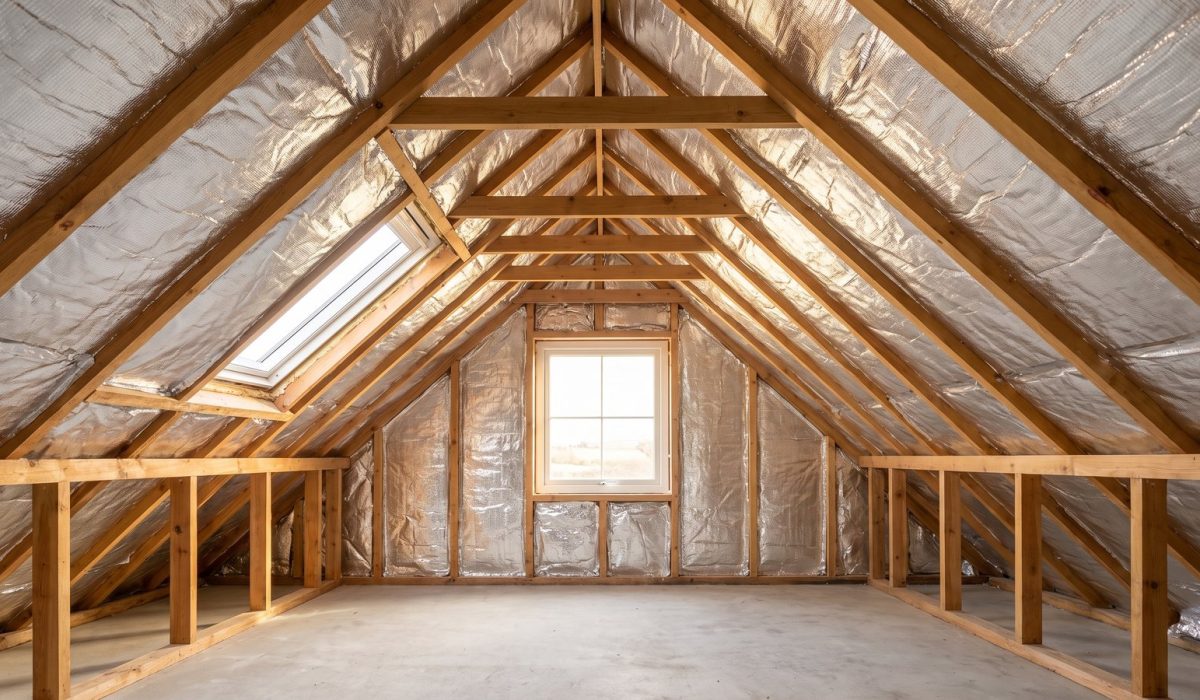
Key Takeaways
- Multifoil is a thin, multi-layer reflective insulation system — not mineral wool or foam.
- Its slim profile suits rafter-level installation where maintaining a ventilation gap is critical.
- It must be installed with correct reflective air gaps on each side to achieve rated performance.
- When correctly installed, it is lender-compatible and preserves roof ventilation.
- Performance varies by product — check for BBA or similar certification.
- Mineral wool at loft-floor level remains the simpler, more universally understood default after removal.
What Multifoil Is
Multifoil insulation — also known as reflective insulation or multi-layer insulation — consists of multiple thin layers of reflective material (typically aluminium foil or metalised film) separated by inner core materials such as wadding, foam, or bubble film. The product relies on the reflective properties of the outer surfaces to reduce radiant heat transfer, and on still-air layers for conductive/convective resistance.
Unlike mineral wool, multifoil is thin — typically 25–40mm — and rigid or semi-rigid in form. Its slim profile is one of its key practical advantages in retrofit rafter-level applications, where depth is constrained.
How It Maintains Ventilation
The critical feature of multifoil installation in a pitched roof context is the air gap requirement. Multifoil systems need at least one — and typically two — reflective air gaps on either side of the product to achieve their rated thermal performance. These air gaps:
- Allow the reflective surfaces to function (a reflective surface touching another surface does not work as a radiant barrier)
- Maintain an air void adjacent to the roof covering, which helps moisture management
- Preserve the ventilation pathway that the roof needs to stay dry
Correctly installed multifoil at rafter level — with a ventilation gap maintained between the product and the underlay/tiles — avoids the ventilation-blocking problem of spray foam. The gap allows air movement; the reflective surface reduces heat loss.
Pros and Cons
Advantages:
– Slim profile suits shallow rafter depths
– Preserves ventilation void when correctly installed
– Lender-compatible in correct configurations
– Relatively easy to install between rafters
– Can supplement other insulation at loft floor level
Disadvantages:
– Performance is critically dependent on correct installation — particularly maintaining the required air gaps; mistakes negate the thermal benefit
– Performance claims from some manufacturers have historically been challenged; look for BBA-certified products
– Not as simple or universally understood as mineral wool
– May not achieve the same equivalent U-value as mineral wool + rigid boards in the same rafter depth
– Costs more per m² than mineral wool for equivalent performance
When It Suits Your Loft
Multifoil is most suitable as a post-removal option where:
- The rafter depth is shallow (e.g., 75–100mm), leaving limited room for conventional insulation while maintaining a ventilation gap
- The roof needs a thin, lightweight insulation layer at rafter level as part of a combined system (e.g., multifoil at rafters, mineral wool at joists)
- The installer is experienced with multifoil systems and understands the air gap requirements
Where the rafter depth is adequate and the loft floor is accessible, mineral wool at joist level remains the simpler and more cost-certain option for most properties.
The Bottom Line
Multifoil can be a neat, practical post-removal option — particularly in shallow rafter-depth properties where maintaining a ventilation gap rules out thicker materials. But installation precision is critical: the air gaps must be maintained, and the product must be certified. If in doubt about the right choice for your specific roof construction, take professional advice before specifying materials.
Request a re-insulation quote that includes multifoil options or book an inspection to assess your loft.
This is general information, not financial advice — please consult a qualified mortgage broker about your circumstances.
Related reading: Best mortgage-friendly loft insulation alternatives · Re-insulating your loft after removal: options & cost · Spray foam & roof ventilation explained