Key Takeaways
- Spray foam offers genuine thermal performance benefits — particularly closed-cell at rafter level.
- However, in UK residential retrofit, it has caused widespread mortgage problems affecting ~250,000 homes.
- ~75% of mortgage providers restrict or refuse lending on foam-affected properties (HOA/BBC).
- All equity-release providers surveyed have refused lending on these properties.
- The problems are: surveyor inspection barrier, moisture trapping, potential timber rot.
- GBIS closed 31 March 2026; the government will not fund removal but is pressing lenders for flexibility.
- The 2026 path: independent PCA-protocol inspection first, then remove + RICS certificate if required.
- Removal costs: approximately £2,800–£8,000 for a standard 100m² loft (plus extras).
What Spray Foam Is
Spray polyurethane foam (SPF) is a two-component insulation material — an isocyanate and a polyol blend — that expands rapidly when mixed and applied, filling cavities and conforming to irregular surfaces. It has been used in construction for decades, in a wide range of commercial, industrial, and residential applications.
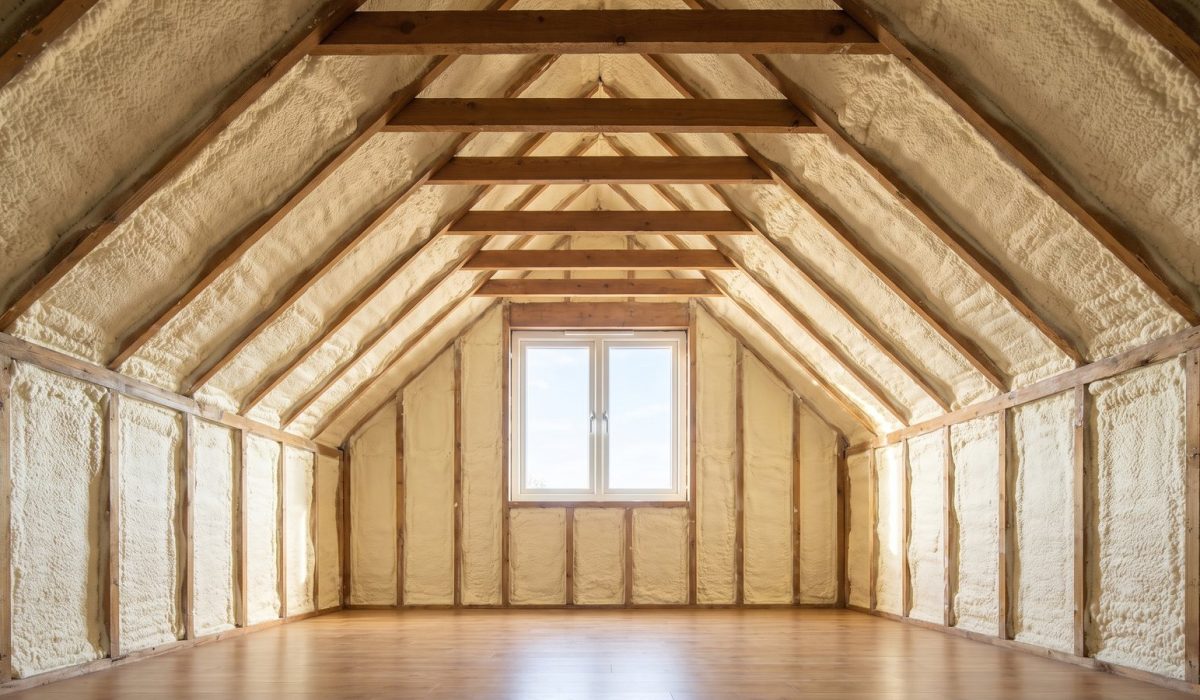
In UK homes, the relevant application — and the source of the current controversy — is the retrofit application of spray foam to the underside of existing pitched roofs: bonded directly to the rafters, underlay, and underside of the roof covering. This was promoted and funded under the Green Homes Grant (2020–2021) and ECO schemes as an energy efficiency improvement.
Spray foam comes in two distinct varieties: open-cell (soft, spongy, vapour-permeable) and closed-cell (rigid, dense, water-resistant). Each has different risk profiles, removal costs, and moisture implications — covered in detail in our comparison guide.
The Benefits: Why It Was Sold
Spray foam’s thermal benefits are real:
High R-value per unit thickness. Closed-cell foam achieves R-6 to R-7 per inch — among the highest available insulation values. This means thinner layers can achieve the same thermal resistance as much thicker conventional materials, which was attractive for retrofit applications where rafter depth limited available space.
Air sealing. Foam can seal air leaks simultaneously with insulation — reducing draughts and convective heat loss in a single application. This is a genuine thermal performance advantage over laid insulation materials, which do not seal gaps.
Moisture resistance (closed-cell). Closed-cell foam is water-resistant — it does not absorb liquid water, unlike some conventional materials. In specific applications (flat roofs, certain specialist construction contexts), this is a meaningful advantage.
Speed of application. A professional team can apply foam to a pitched roof in a matter of hours, compared to a more involved installation process for equivalent-performance conventional materials.
These are genuine advantages. The problem — as the UK experience has demonstrated — is that these advantages in the right application context became serious liabilities in the specific context of UK residential pitched-roof retrofit.
The Risks: Moisture, Mortgages and Resale
Moisture and Condensation
The most significant physical risk from spray foam on UK pitched roofs is moisture management. A traditional UK cold-roof construction depends on ventilation — air flowing from eaves to ridge through a void between the insulation and the roof covering — to manage moisture and keep roof timbers dry.
Spray foam, applied to the underside of the roof slope, can seal this void entirely. Warm moist air from the house, unable to escape, condenses against the cold underside of the roof covering. That condensation deposits moisture against the timber rafters — over months and years, driving timber moisture content above the threshold for biological decay. Wet rot and dry rot can develop in the zone hidden beneath the foam surface.
BS 5250:2021 (moisture management) and Approved Document F (ventilation) address these risks explicitly. Many grant-era installations did not adequately account for them. See our condensation guide for a full technical explanation.
The Inspection Barrier
Beyond the moisture risk, spray foam creates a structural survey problem. The foam bonds directly to the rafters — and when a mortgage surveyor visits the property, they cannot see, tap, or probe the timber beneath. RICS guidance confirms that where timbers cannot be adequately inspected, the surveyor must note this limitation. Lenders receiving that report cannot quantify their structural risk, and they apply conservative criteria: restriction or refusal.
This is the core mechanism behind the mortgage crisis. The foam does not have to have caused damage for the lender to refuse — the inability to confirm the timber’s condition is sufficient.
Resale and Value Impact
The effect on property value is primarily through reduced buyer pool. If approximately 75% of mortgage lenders refuse to lend on a foam-affected property, approximately 75% of mortgaged buyers cannot compete. The resulting restriction on competition leads to lower achieved prices and, in some cases, complete inability to sell within a reasonable timeframe. See our value impact guide.
The UK Mortgage Crisis: ~250,000 Homes
The scale of the problem is significant. Approximately 250,000 UK homes are affected by spray foam insulation (House of Commons Library, Mortgage Strategy, HOA research). Much of this foam was installed under government-backed schemes:
- The Green Homes Grant (2020–2021) funded installation in tens of thousands of homes.
- ECO3 and ECO4 schemes have funded foam in a further significant number.
- Private installation adds to the total.
Research by the Homeowners Alliance, widely reported by the BBC, found that approximately 75% of mortgage providers restrict or refuse lending on foam-affected properties. All equity-release lenders surveyed — every one — have refused. More than 50 lenders are listed as restricting foam properties.
The numbers have, if anything, worsened since 2022–2023. Lenders that previously took a case-by-case approach have formalised restrictive policies as the surveying profession has developed clearer guidance on flagging foam properties.
Costs of Removal
For homeowners who need to resolve the situation, professional removal is the main route. Guide costs for a standard 100m² loft:
| Item | Guide range |
|---|---|
| Open-cell foam removal | £25–40/m² |
| Closed-cell foam removal | £40–65/m² |
| Standard 100m² loft (total) | £2,800–£8,000 |
| Timber repairs (if needed) | £200–£1,000+ |
| Breathable re-insulation | £300–£1,500+ |
| Independent RICS certificate | From ~£349 |
| Realistic total | £4,000–£10,000+ |
These are guide ranges only — a site survey is required for a fixed price. See our full cost guide for a detailed breakdown.
Your Options in 2026
The recommended decision framework:
Step 1: Independent PCA-Protocol Inspection
The Property Care Association Spray Foam Inspection Protocol (2023) provides a standardised methodology for assessing foam-affected properties. A PCA-registered surveyor produces a report documenting foam type, installation quality, timber condition, ventilation, and overall risk classification.
This inspection is always the right starting point. It establishes objective facts before any removal decision is made. In genuinely low-risk cases, some lenders will consider proceeding without removal based on the report. In higher-risk cases, it guides the scope of removal work.
Step 2: Specialist Mortgage Broker
A broker with experience in spray-foam properties knows, in real time, which lenders are currently most flexible and how to structure an application. This knowledge is more accurate than any published list, as lender criteria change regularly. A specialist broker is essential between the inspection and any removal decision — they may identify a lender route that avoids removal entirely in low-risk cases.
Step 3: Professional Removal and RICS Certificate (if required)
If the lender requires removal, or if the inspection reveals significant risk, professional removal by an experienced firm followed by an independent RICS-verified certificate is the dependable resolution. This restores the property to standard mortgageability with most mainstream lenders.
The 2026 Outlook
The situation is improving slowly, but not fast enough for most homeowners with near-term transaction needs:
Government pressure on lenders — to be more flexible with grant-installed homes — has created awareness without producing a binding policy change. As of June 2026, most mainstream lenders have not materially loosened their criteria in response.
PCA inspection protocol adoption — is growing. More lenders consider these reports in low-risk cases than did two years ago. The trend is positive but the pace is slow.
GBIS closure — the Great British Insulation Scheme closed 31 March 2026. ECO4 continues to December 2026; Warm Homes: Local Grant to March 2028. Neither funds removal.
The practical advice remains: act on today’s reality, not anticipated future flexibility. If you need to sell, remortgage, or release equity in the next one to two years, do not wait for a policy shift that has not yet materialised.
The Bottom Line
Spray foam offered genuine thermal benefits that attracted both commercial installers and government-backed schemes. Applied to UK residential roofs in the way it was — often without adequate attention to ventilation, moisture management, or future mortgageability — it has created a significant problem for hundreds of thousands of homeowners.
The honest, balanced assessment in 2026 is this: if you have spray foam on your roof timbers, the sensible path is to get it independently inspected, understand the risk to your roof and your mortgage options, and remove and certify if required. That is a manageable, well-documented process. And it is far better to approach it with clear information and no pressure than to act in panic or in response to a cowboy removal firm.
Book an independent PCA-protocol inspection — the right first step, every time.
Request a removal quote when you are ready to take the next step.
This is general information, not financial advice — please consult a qualified mortgage broker about your circumstances.
This is the cornerstone article on spray foam insulation for sprayfoamremovalcompany.co.uk. Related reading spans all seven clusters:
Mortgages: Why lenders reject spray foam · Mortgage declined? Next steps
Problems: 7 warning signs · Condensation & moisture · Timber rot
Removal: How it’s done professionally · The PCA protocol · Cost guide
Alternatives: Mortgage-friendly alternatives · Mineral wool vs spray foam